




Skateboard Wheels Guide: Size, Durometer & Street vs. Cruiser
Wheels might be the most underrated part of your setup. Riders will agonize over a deck brand for a week, then grab whatever wheels come on the shelf and wonder why their board feels slow, sketchy on rough ground, or won't slide when they want it to. The truth is, your wheels of skateboard decide how you roll: your speed, your grip, how you land, and whether cracks in the pavement stop you dead.
At SkatesUSA, we've mounted every kind of wheel you can imagine, from tiny 99a street wheels to big soft 78a cruisers. The two numbers on the side of every wheel size in millimeters and durometer (hardness) tell you almost everything about how it will ride, once you know how to read them.
This guide breaks down skateboard wheel size and durometer in plain English, explains the difference between street and cruiser wheels, and helps you pick the perfect set for how (and where) you actually skate. Let's roll.
Why Your Wheels Matter More Than You Think
Your wheels are the only part of your board that touches the ground, so they shape every second of your ride. The right set can make a cheap board feel fast and smooth; the wrong set can make a pro setup feel like a shopping cart. Three things about a wheel change how it performs:
-
Size (diameter): how fast you roll and how quickly you accelerate.
-
Durometer (hardness): how much grip, slide, and shock absorption you get.
-
Shape & urethane: how the wheel grips, slides, and holds its speed over time.
Get these matched to your style and terrain, and everything else about skating gets easier. Here's how to read each one.
Skateboard Wheel Size, Explained (Diameter in mm)
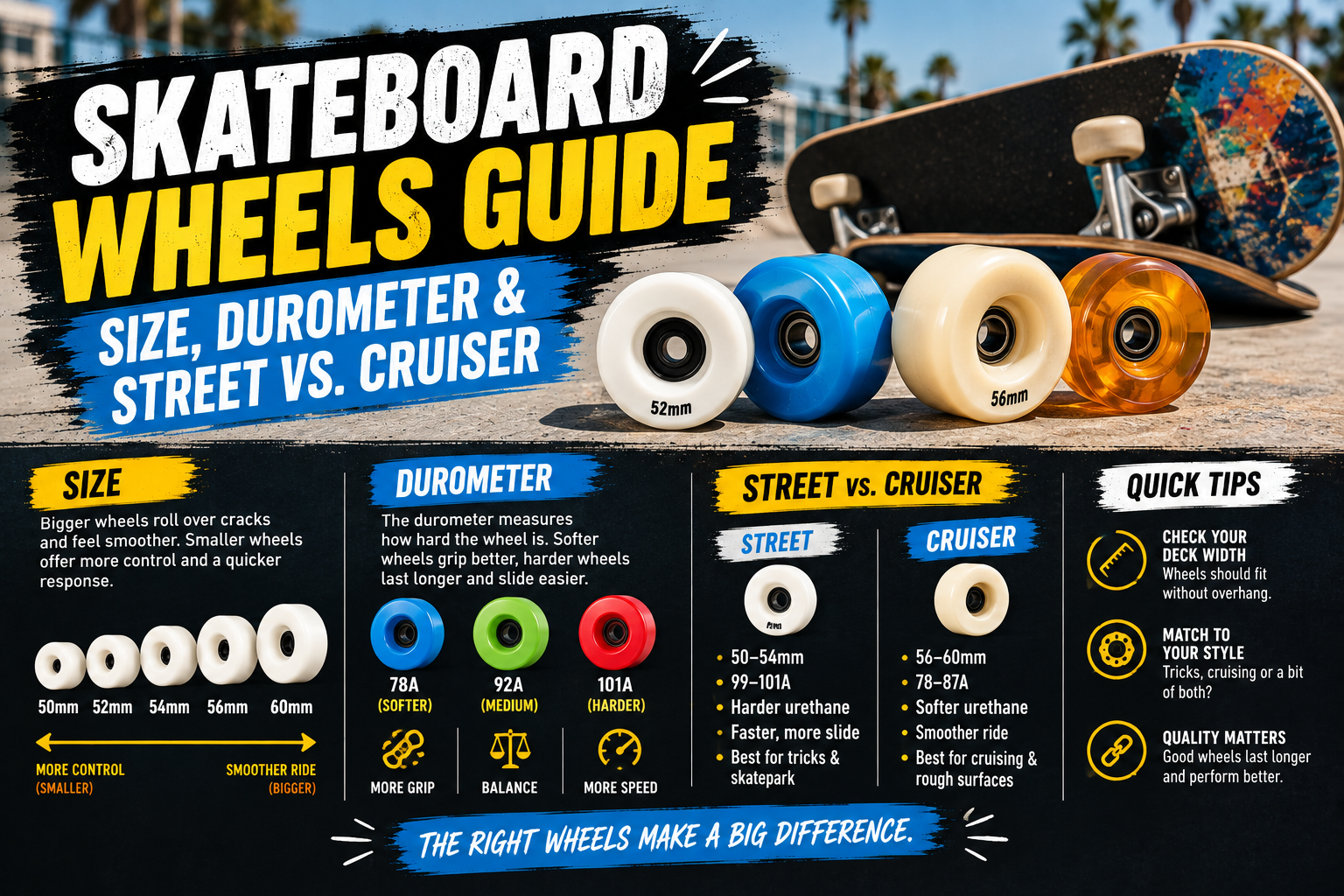
Wheel size is measured in millimeters (mm) across the diameter. Smaller wheels are lighter and accelerate faster but have a lower top speed; bigger wheels take more effort to get going but carry more speed and roll over cracks and rough ground far better. Here's the quick map:
-
50–53mm – Small: Light, low to the ground, and quick to accelerate. Favored by technical street skaters for flip tricks, but you'll feel every pebble.
-
54–56mm – The all-around sweet spot: The most versatile range and the best starting point for most skaters. Great for street and skatepark alike 54mm is the classic default.
-
56–60mm – Bigger & faster: More speed and better roll for transition, ramps, bowls, and vert, plus a smoother ride on rough streets.
-
60mm+ – Cruiser & longboard territory: Maximum speed and roll-over. Almost always paired with a soft durometer for cruising and commuting.
Rider Note: Big wheels and a standard deck can cause wheelbite the wheel touching the deck mid-turn and stopping you dead. As our own setup team puts it: riding 54mm+ for speed or transition? Go with High trucks so your wheels don't bite. Skating technical street on 50mm? Low trucks give you a quicker pop.
Durometer: What Wheel Hardness Really Means
Durometer is the measure of a wheel's hardness, shown as a number followed by an “a” (for example, 99a). The higher the number, the harder the wheel. Hardness is the single biggest factor in how a wheel feels, because it controls the trade-off between grip and slide:
-
78a–87a – Soft: Grippy, smooth, and quiet. They soak up cracks and rough pavement, making them the go-to for cruising, commuting, and rough ground. Slower to slide and can feel “sticky” for tricks.
-
88a–95a – Medium / hybrid: A middle ground with some grip and some slide. A smart choice for rough streets and for beginners who want a little forgiveness.
-
96a–99a – Hard: The standard for street and park. Fast, poppy, and easy to slide for tricks, with less grip. If in doubt, 99a is the do-everything classic.
-
100a–101a – Very hard / pro: The fastest and slidiest, with the least grip. Best on the smooth surfaces of a skatepark; harsh on rough ground.
Rider Note: You may also see a “b” durometer (like 84b) on some of the hardest wheels. The B scale simply measures very hard urethane the A scale can't it reads about 20 points lower, so 84b is roughly 104a. Don't let it confuse you: b just means “very hard.”
Contact Patch, Shape & Cores The Details Pros Obsess Over
Once you've got size and hardness dialed, a few finer details separate a good wheel from a great one:
-
Contact patch: the width of wheel that actually touches the ground. A wider patch means more grip and stability (great for transition); a narrower, conical patch slides more easily with less friction (great for technical street).
-
Lip shape: a sharp, square lip digs in for grip and lock-in on grinds, while a rounded lip releases into slides and carves more smoothly.
-
Cores: many performance wheels hide a hard plastic core inside the urethane. Cores cut weight, help the wheel sustain speed, keep bearings seated, and manage heat which is why cored wheels feel noticeably faster and livelier.
-
Urethane formula: the quality of the urethane is what resists flat spots (from locked-up slides) and keeps your wheels rolling fast for months. This is where the big brands earn their reputation.
Street vs. Cruiser Wheels: The Big Decision
Almost every wheel question comes down to this one fork in the road. Choose the profile that matches how you want to ride:
Street & Park Wheels
Small and hard typically 50–56mm and 99a–101a. They're built for tricks: fast pop, easy slides, and a predictable feel on the smooth concrete of a skatepark or a clean ledge. On rough pavement, though, they're loud and jarring and will hang up on small rocks.
Cruiser & Soft Wheels
Bigger and softer usually 54–60mm+ and 78a–87a. They roll over cracks, pebbles, and rough roads with a smooth, grippy, quiet ride, which makes them perfect for commuting and cruising. The trade-off: they're slower to slide and less ideal for technical flip tricks. Many are labeled SHR (Super High Rebound) for extra bounce and roll speed.
Shopping by profile? Browse street & park skateboard wheels or dedicated cruiser wheels and if you're rolling a longboard, see our longboard wheels.
The Best Skateboard Wheel Brands (and What They're Known For)
A great formula is what you're really paying for. These are the wheel brands we trust most:
Spitfire
The most iconic wheel brand on earth. Spitfire's Formula Four urethane is fast, hard-wearing, and famously flat-spot resistant a benchmark for street and park skaters. Shop Spitfire →
Bones
Bones offers two legends: STF (Street Tech Formula), which stays fast and resists flat spots on street, and SPF (Skatepark Formula), a harder, ultra-durable wheel built for smooth parks and rough terrain. Shop Bones →
OJ Wheels
OJ covers the full spectrum, from hard street wheels to super-soft 78a cruisers with big, grippy contact patches a great pick if you want one brand for tricks and one for cruising. Shop OJ →
Ricta
Ricta is best known for Clouds 78a soft wheels that cruise rough ground but stay small enough for tricks plus fast race-formula street wheels. A brilliant hybrid brand. Shop Ricta →
We also stock cruiser favorites like Slime Balls and Shark Wheel, high-rebound Powell Peralta Dragon Formula, and unbeatable value from Mini Logo. Browse the full wall of skateboard wheels to compare.
How to Choose the Right Wheels for You
Match the wheel to your skating and terrain and you'll never guess again:
-
Technical street & flip tricks: 50–53mm, 99a–101a, narrower contact patch.
-
All-around street & park (and beginners): 54–56mm, 99a the safest do-everything choice.
-
Transition, ramps & bowls: 56–60mm, 97a–99a, wider contact patch for grip and speed.
-
Cruising, commuting & rough ground: 54–60mm+, 78a–87a soft wheels.
-
Not sure yet? A pre-built complete skateboard comes with sensible all-around wheels to start.
Can You Put Cruiser Wheels on a Regular Skateboard?
Yes and it's one of the best upgrades out there. Dropping a set of soft 78a–83a wheels onto your normal popsicle deck instantly turns it into a comfortable street cruiser that eats up rough pavement. There's just one thing to manage: wheelbite.
Because cruiser wheels are bigger, they can rub the deck when you turn hard. The fix is simple: add riser or shock pads between your trucks and deck to lift the board, and use slightly longer hardware to account for the extra height. A rough guide: for wheels up to 55mm use a 1/8″ shock pad or 1/4″ riser; for wheels up to 60mm, step up to a 1/4″ shock pad or 1/2″ riser. Pairing them with High trucks helps even more.
Prefer a board that's ready to cruise out of the box? Skip the build and grab a complete cruiser or explore our cruiser skateboards.
How to Tell When It's Time for New Wheels
Wheels wear out gradually, so it's easy to ride a tired set longer than you should. Swap them when you notice any of these:
-
Coning (uneven wear): always turning the same way wears the inner edge into a cone shape, killing grip. Rotate your wheels regularly to even this out and make them last longer.
-
Flat spots: locking up a slide can grind a flat patch that makes the wheel thump and vibrate. Quality urethane resists this, but no wheel is immune.
-
Cracks or chunks: missing chunks or cracks around the edge mean the urethane is done replace them before one lets go mid-ride.
-
Worn down small: wheels shrink as they wear. Once they're noticeably smaller and slower, a fresh set will feel like a brand-new board.
Ready to Upgrade Your Ride?
Now you can read any wheel on the shelf like a pro. Whether you're chasing pop for the park or a buttery-smooth cruise to work, the right set is waiting. Browse all skateboard wheels, grab a set of soft cruiser wheels, or start fresh with a complete skateboard at SkatesUSA with free shipping on orders over $50.
